

Software isn’t created in an instant by piling endless lines of code — it requires time, a structured approach, and strategic roadmapping. While the software development life cycle (SDLC) and software testing life cycle (STLC) may seem like worlds apart in the software creation process, they harmoniously complement each other for the sake of reliable, resilient, and functional systems.
Although STLC comes as both a fully independent framework and an integral part of SDLC, it isn’t a substitute for the latter. In our experience, aligning both life cycles while building software is critical, as it accelerates delivery with no damage to quality, reduces costly rework, and lowers the risk of devastating performance, security, and compliance issues.
So, what’s the definition of SDLC and STLC, what are SDLC phases vs. STLC phases, how do they compare, and what are their relationships across diverse methodologies? Go on reading to find out.
What Is the Software Development Life Cycle?
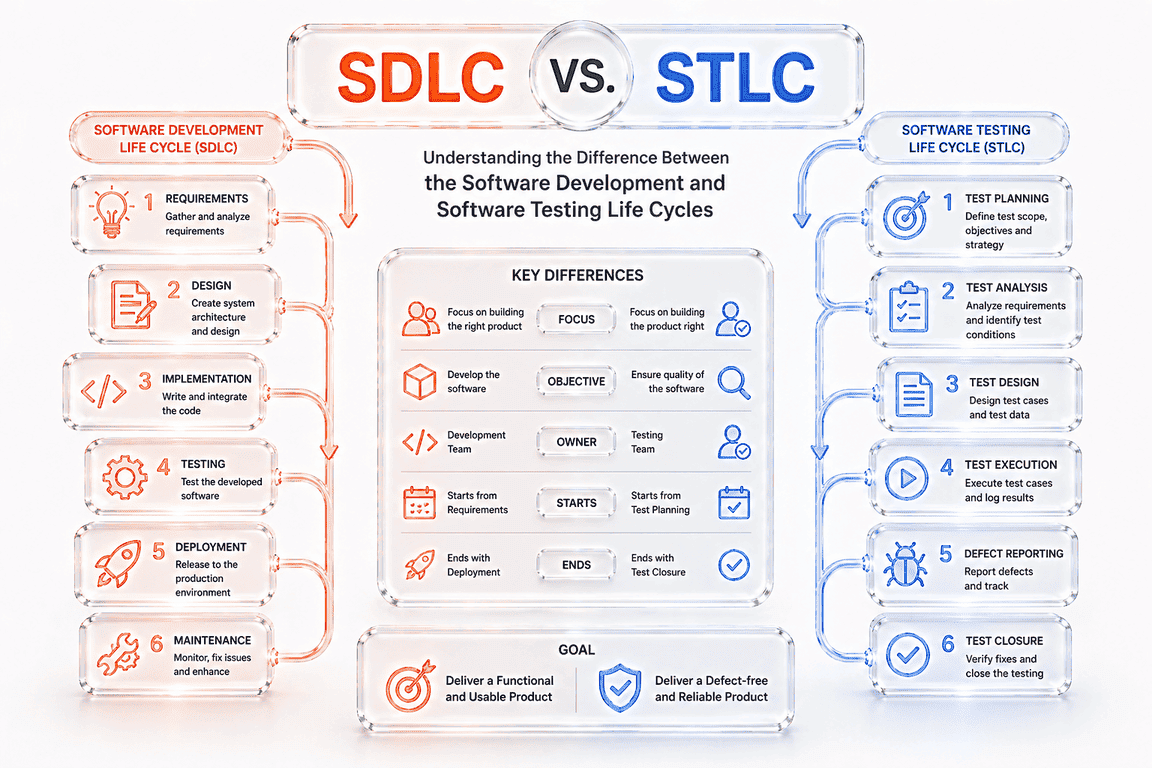
The software development life cycle is an organized framework that technical specialists use to design, build, validate, deploy, and maintain software solutions. The purpose of SDLC is to provide a roadmap for the entire development journey, outlining key goals, activities, stakeholders, and deliverables, and ensuring full alignment with the requirements of a specific business.
Common SDLC phases and deliverables
A clear and consistent SDLC process spins several essential phases, including business analysis, UI/UX and architectural design, implementation, testing, and maintenance and support. The following is an overview of each stage, highlighting goals, outputs, stakeholders, artefacts, and their sequence in Waterfall, Agile, and DevOps.
1. Business Analysis
Goals:
- understand unique business and user expectations
- determine the scope of the project and ballpark estimates
- pinpoint the necessary system requirements
- identify potential risks, constraints, and success benchmarks
Outputs:
- clearly defined functional and non-functional requirements
- confirmed project scope and objectives
Stakeholders:
- business analysts
- product owners
- project managers
- end users
Artefacts:
- Business Requirement Document (BRD)
- Software Requirement Specification (SRS)
- user journeys
- feasibility analysis
Methodologies:
- Waterfall: phases are executed in sequence
- Agile: software development stages are iterative and incremental
- DevOps: development is continuous and refined based on the feedback received
2. Design
Goals:
- translate business requirements into an architectural vision
- define user flows and experience
- plan data streams, integrations, and interfaces
Outputs:
- approved system architecture
- solution blueprint
- identified technology stack
- defined system components and interfaces
- validated UI/UX approach
Stakeholders:
- solution architects
- UI/UX designers
- senior developers
- security specialists
Artefacts:
- architecture diagrams
- software architecture reviews
- technical specifications
- database schemas
- user personas
- mock-ups, wireframes, and prototypes
- API specifications
Methodologies:
- Waterfall: occurs before coding
- Agile: transpires during every sprint
- DevOps: aligned with current scalability and automation needs
3. Coding
Goals:
- implement features based on the design
- integrate system components
- ensure code quality and reliability
Outputs:
- functional software modules
- integrated system components
- unit-tested code
Stakeholders:
- developers
- technical leads
- QA engineers for unit tests
Artefacts:
- source code
- unit tests
- build scripts
- code documentation
Methodologies:
- Waterfall: happens after design
- Agile: occurs incrementally in each sprint
- DevOps: transpires continuously, integrated with automated testing and deployment
4. Testing
Goals:
- validate software for bugs and alignment with requirements
- verify functionality, performance, usability, and security
- identify bottlenecks and ensure their resolution
Outputs:
- error-free software build
- list of identified defects
- test execution results and quality assessments
Stakeholders:
- QA engineers
- developers
- product owners
- project managers
Artefacts:
- test plans and test cases
- bug and text execution reports
- automation scripts
- User Acceptance Testing documentation
Methodologies:
- Waterfall: happens after coding
- Agile: occurs iteratively
- DevOps: takes place continuously and automatically in CI/CD pipelines
5. Deployment
Goals:
- release the software to production
- ensure environment readiness and stability
- make the system available to end users
Outputs:
- software availability
- operational launch
Stakeholders:
- DevOps engineers
- system administrators
- release managers
- support teams
Artefacts:
- deployment scripts
- release notes
- configuration files
- rollback plans
Methodologies:
- Waterfall: big-bang release
- Agile: incremental development
- DevOps: continuous delivery and deployment
6. Maintenance
Goals:
- resolve post-launch issues
- improve performance and security
- implement the required updates and enhancements
Outputs:
- stable and updated software
- performance and reliability refinements
Stakeholders:
- support engineers
- developers
- system administrators
Artefacts:
- patch releases
- change logs
- updated documentation
- incident reports
Methodologies:
- Waterfall: maintenance as a final phase
- Agile: continuous backlog-driven improvements
- DevOps: ongoing monitoring and optimization
What Is the Software Testing Life Cycle?
The software testing life cycle is the sequence of activities that QA teams take to plan, prepare, execute, and close testing tasks. In modern software engineering, STLC as part of SDLC integrates automation and continuous testing to validate solution quality from the very beginning of development until product launch.
Why STLC is important is that it makes SDLC more systematic, cost-effective, and high-quality, as developers code faster and more accurately, making businesses gain measurable dividends, and users enjoy seamless software experiences.
Common STLC phases and deliverables
A typical STLC is composed of requirement analysis, test planning, test case development, test environment setup, test execution, and test closure. Below, PFLB draws on its practical experience with clients and breaks down each of these phases, describing relevant goals, outputs, and responsibilities that testers, QA engineers, and test leads assume:
1. Requirement Analysis
Goals:
- understand and review requirements to identify what software parts needs testing
- ensure requirements are complete and testable
Outputs:
- Requirement Traceability Matrix (RTM)
- list of testable conditions
Responsibilities:
- testers and QA engineers: review and clarify requirements
- test leads: ensure full coverage of all critical demands
2. Test Planning
Goals:
- define testing strategy, scope, resources, schedule, and risk mitigation
- plan the overall approach for testing activities
Outputs:
- test plan document
- devise a relevant strategy and approach
- define resource and effort estimates
Responsibilities:
- testers and QA engineers: provide input and feedback on testing requirements and feasibility
- test leads: create and approve the test strategy, define priorities, and coordinate with stakeholders
3. Test Case Development
Goals:
- design detailed test scenarios and scripts to validate system behavior
- prepare data for testing
Outputs:
- test cases and scripts
- test datasets
- automation scripts
Responsibilities:
- testers and QA engineers: write test cases and develop automated test scripts
- test leads: review and approve test cases, identify gaps in test coverage, and oversee the process
4. Test Environment Setup
Goals:
- prepare hardware, software, tools, and configurations necessary for testing
- ensure the environment mirrors production as closely as possible
Outputs:
- configured test environment
- reports on environment readiness
Responsibilities:
- testers and QA engineers: set up and validate the test environment, install the required software tools, and ensure configurations match existing testing requirements
- test leads: review and approve the environment setup, coordinate with DevOps and system administrators, ensure the environment meets the test strategy, and resolve any emerging issues
5. Test Execution
Goals:
- execute test cases and identify defects
- verify fixes and track progress
Outputs:
- test execution results
- bug reports
- updated test status reports
Responsibilities:
- testers and QA engineers: run test cases, log defects, retest fixed issues, and report progress
- test leads: monitor overall test execution, ensure coverage of all test scenarios, prioritize defects, coordinate with developers for fixes, and provide status updates to stakeholders
6. Test Closure
Goals:
- evaluate overall testing outcomes
- document lessons learned and confirm test completion
Outputs:
- test summary report
- defect analysis report
- test closure sign-off
Responsibilities:
- testers and QA engineers: complete the necessary documentation and prepare reports
- test leads: review and approve closure documents, evaluate testing effectiveness, identify gaps and improvement opportunities, and formally communicate test closure to stakeholders
SDLC vs. STLC comparison
Although STLC is often considered an independent subset of SDLC that focuses solely on software testing, the boundaries between the two often blur in modern methodologies like Agile and DevOps. In these approaches, testing activities always happen simultaneously with coding or are performed continuously within CI/CD pipelines.
At the same time, the two processes have some vivid distinctions. The SDLC and STLC difference is manifested through their objectives, stages, stakeholders involved, and other critical aspects.
Based on the expertise of the PFLB team, we’ve compiled an SDLC vs. STLC table of differences to share insights with QA crews:
| Aspect | SDLC | STLC |
|---|---|---|
| Definition and Scope | Covers the entire software creation life cycle | Testing activities occur within the SDLC |
| Objectives | Aims to deliver functional software that meets business requirements | Ensures software is defect-free and conforms to quality standards |
| Phases | Business analysis → design → coding → testing → deployment → maintenance | Requirement analysis → test planning → test case development → test environment setup → test execution → test closure |
| Stakeholders Involved | Business analysts, solution architects, UI/UX designers, developers, testers, product owners, project managers, business owners | QA engineers, testers, test leads, developers, product owners |
| Outputs | Software, technical, and design documentation, deployment artifacts | Test plans, test cases, defect reports, execution and closure reports |
| Execution Order | Sequential (Waterfall); iterative (Agile); overlapping phases (DevOps) | Can start as soon as requirements are available; often runs in parallel with development; supports continuous testing |
Why Both SDLC and STLC Matter
The SDLC vs. STLC approaches are tightly interconnected and dependent on each other. Excluding testing from the SDLC pipeline can introduce serious risks like undetected bugs that will only accumulate over time. As a result, it’ll be impossible to roll out software when expected, or expensive redesigns will be required.
Likewise, leaving out validation from the broader SDLC carries certain threats, such as misaligned requirements, scope creep in testing, overlooked edge cases, and the inability of the end product to meet the defined business and user expectations.
The only rational way out that’s left for organizations is to intertwine SDLC and STLC. Integrating testing and development life cycles guarantees that bottlenecks are identified before migrating to production, which can save precious time for development teams and high costs for businesses. Plus, the software built incrementally and without missing vital phases offers better quality, behaves more predictably under normal and peak conditions, and appeals more easily to end users. Other advantages of combining SDLC and STLC for software development projects are outlined below.
Benefits of integrating SDLC and STLC
- Early risk mitigation: The earlier you follow the SDLC roadmap step by step, the easier it will be for you to prevent production delays and costly system rework.
- Continuous feedback loops: QA testers provide instant and continuous feedback to developers, which enables quicker fixes and higher-quality code.
- Improved traceability: Test cases meticulously linked to functional and non-functional requirements ensure that each software feature doesn’t miss validation and functions as intended.
- Closer collaboration between developers and testers: Developers and testers who work together from the onset of the project can avoid misunderstandings, have a unified vision on priorities, and support shared ownership of quality.
- Faster delivery: Implementation and testing stages occurring in parallel accelerate release cycles, making software available to end users much sooner than expected.
Recognizing the importance of aligning SDLC and STLC is half the battle — finding a partner to whom you can entrust the STLC process is winning it. PFLB software testing services will perfectly integrate into your current development pipeline and deliver supreme quality at every stage — for the software that your users will instantly like.
SDLC vs. STLC in Different Methodologies
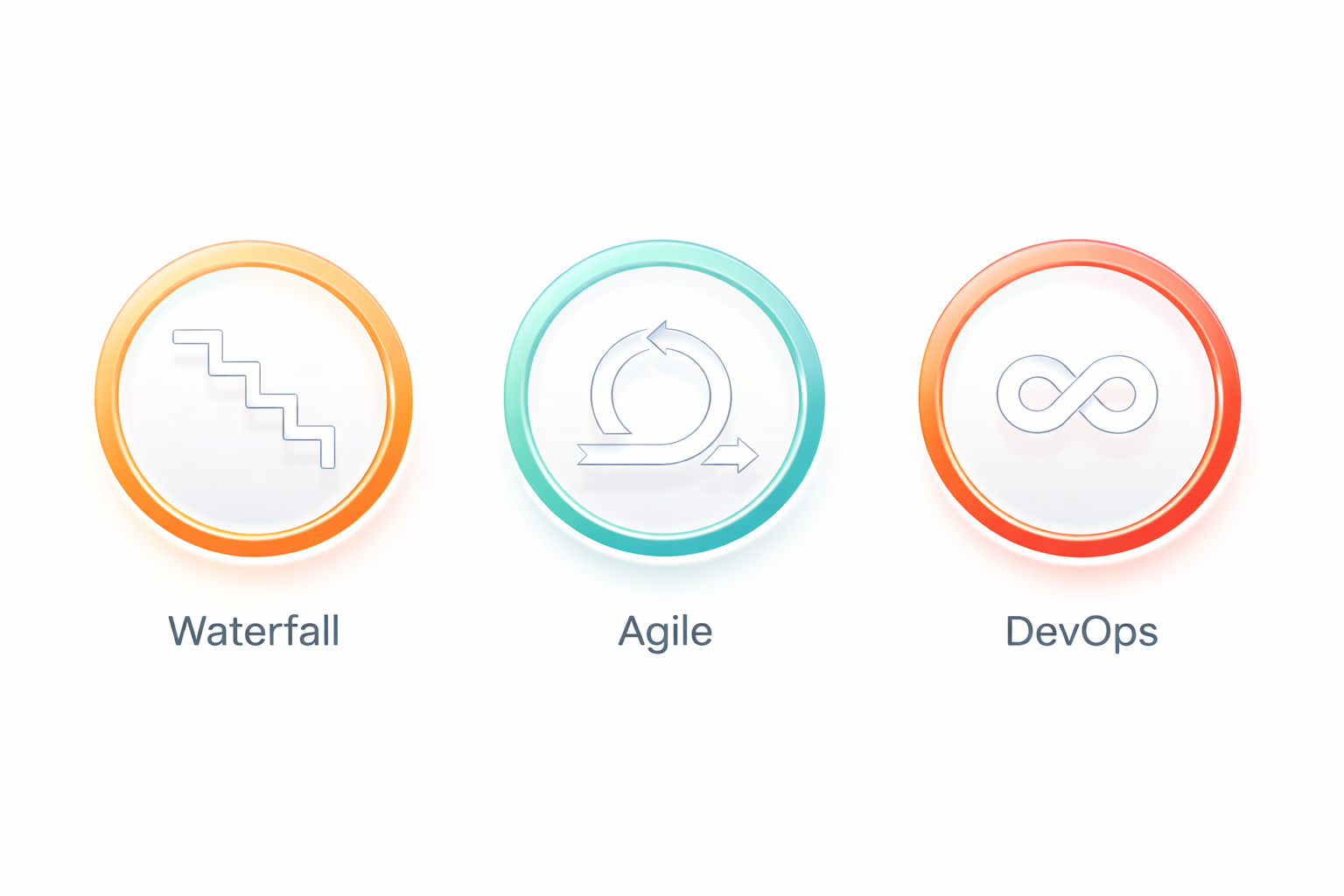
SDLC vs. STLC in Agile and DevOps, as well as Waterfall, behave differently depending on how and when their relevant activities are integrated:
- Waterfall: SDLC stages strictly follow one another, with STLC occurring only after development is complete. Although offering a clear structure, the Waterfall model carries the risk of late defect discovery, which can lead to delayed releases and post-implementation rework.
- Agile: STLC activities are incorporated within sprints and run concurrently with software development. Because of frequent iterations, test planning and automation are critical to ensure robust system quality and timely rollout.
- DevOps: Continuous integration and deployment rely on continuous testing. STLC is an ongoing process triggered automatically for each build, allowing for rapid feedback and faster releases.
Best Practices for Aligning SDLC and STLC
As a developer or business, you shouldn’t view it as a testing life cycle vs. development life cycle. Quite the opposite, you should put in effort to align both processes for a smooth software development journey. The following practices, taken from the practical work of the PFLB team, will make the process easy and without a hitch:
- Engage QA teams in the SDLC from the initial business analysis and design phases. This will help build reliable test strategies and identify testability issues early enough.
- Remember to implement requirement traceability matrices. Doing so will ensure that all features are covered by tests, and no functionality is overlooked.
- Invest in test automation and infrastructure to run test cases continuously as part of the STLC. This will enable early bug detection and resolution.
- Encourage collaboration between developers, testers, and business stakeholders from the very beginning of the project. Holding joint reviews and retrospectives will ensure teams align on project changes, share feedback, and improve holistically.
- Rely on metrics like defect leakage, cycle time, rework percentage, and others to monitor the effectiveness of SDLC and STLC integration.
Frequently Asked Questions About SDLC and STLC
- Is STLC a part of SDLC?
White STLC can be an independent framework, it’s mainly perceived as a testing process within the broader SDLC.
- Can SDLC phases and STLC phases run in parallel?
Yes, SDLC vs. STLC examples can run simultaneously, especially in Agile and DevOps. For example, QA specialists can review user stories while features are still being planned and design test cases when developers write code.
- Which is more important, SDLC or STLC?
Both are equally important, as they serve complementary purposes and must be aligned for healthier software.
- What happens if you skip STLC activities?
Ignoring STLC activities can have devastating consequences for the project. Among them are defects escaping into production, costly fixes, delayed releases, the erosion of user trust, and many others.
Final Thoughts
Effective and unbreakable software starts with careful planning. To ensure your system arrives on time and offers salient features, interactive interfaces, and seamless user flows, SDLC and STLC should be perceived as allies, not rivals. Understanding the differences and synergizing these two frameworks will enable teams to design better processes, allocate resources more prudently, and instill quality from the earliest stages of development.
Before you start a new project, evaluate whether SDLC and STLC are aligned in your company and adopt relevant best practices if not. And in case you encounter any testing gaps in your processes or teams, count on PFLB.
In addition to general software validation, we provide utility, financial, gas & oil, and e-commerce load testing, helping businesses of all sizes make their software powerful even under stress.